Tuesday, February 26, 2008

Nashville -- Feb. 22-24

View out the window of the Hampton Inn at downtown Nashville


On Saturday, during the Blood Water Board Meeting, I walked around a bit, including going into the Country Music Hall of Fame (http://www.countrymusichalloffame.com/site/), right across the street from our hotel. The Museum store was having a grand reopening that day and there was a live performance by Jim Lauderdale. You may wish to go to his MySpace and listen to "I Met Jesus in a Bar." (http://www.myspace.com/jimlauderdale) I actually thought he was quite good, playing a combination of country and bluegrass.

Dad/Steve with Aaron Sands
Dad/Steve with Dan and Katie Haseltine

India Journal Break

Unfortunately, our camera became full and I was dependent on others for the pictures in the next leg of our journey. I have not received these yet, so you will have to stay tuned (I hope not toooo long--you know who you are and what you need to do) for the next India Journal entry. In the meantime I am posting a few bits of local news.

These little bits of ice (below) on a couple of different mornings have garnered us the much beloved 2-hour delay opening of school and even a "snow" day last Friday. That was very good timing because that was the day we went to Nashville.


Our hibiscus are flowering in winter inside. Yes, they may look a bit scraggly otherwise, but nevertheless, they have expended the strength to flower. (There's a metaphor in there for life, I'm sure.) Since these pictures, there have been at least three more blooms.


And despite the fact that Christmas passed long ago, our poinsettias are still pretty, instead of the usual sad and barren plants they often become by this time.

Monday, February 18, 2008

India Journal -- Part 4 -- Jan. 2-4 --Paradise

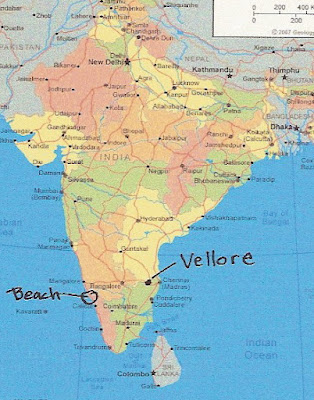
If you have very sharp eyes or a magnifying glass, the map below might give you a sense in the whole scheme of things as to where Vellore and our beach stay written about below are. Or, better yet, just do "google maps" for "Vellore, India" and "Kerela."

We arrived by train the morning of January 2 (Wednesday) in a city I can't remember the name of (Can anyone help me out here and I'll edit?). A little white hired car looking like it stepped out of a 1930s or 40s movie and its driver were waiting for us thanks to Elliott. It was quickly surmised that seven of us plus our luggage (albeit light for a big trip) were not going to fit into the car. So another identical little white hired car was quickly engaged and we were split between them.

While this was going on, one of our saddest beggars came scuttling around our feet. His legs were bent and seemingly useless and he scooted on his bottom using his hands. It so much reminded me of the legless beggar in A Fine Balance by Rohinton Mistry. This beggar, who plays a major part in the book, was probably purposely maimed as an infant in order to make him a more effective beggar--as at least used to be not uncommon. In the book, beggars were part of groups controlled by a beggar master (like a pimp) who got all the income and supported the beggars out of it in some meager fashion. Elliott says this is still prevalent and that that is why you should find other ways to help beggars than giving them alms, as they will be taken away from them.

Steeling ourselves for another car drive, we were whisked away through the town and then out of it and into more village-like settings, down narrow lanes, realizing from the smell and type of the vegetation that we were coming near the ocean. Finally, we drove down a dirt path with high dirt banks (above the car) on either side and stopped. We had arrived!

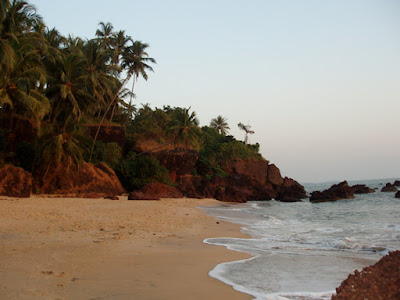
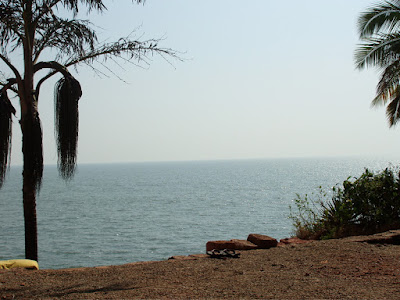
We stretched, got luggage, and filed through a narrow gate, took a few steps towards the edge of the bluff. . . and this is what we saw -- paradise on the Arabian Sea!
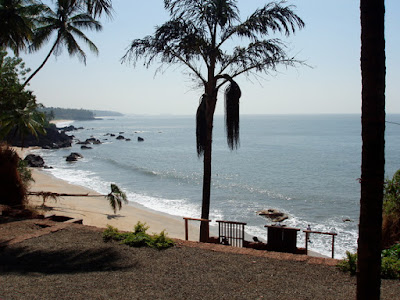


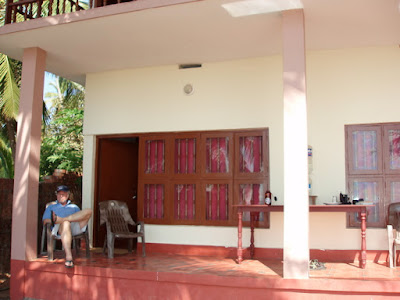
Turning around the other way was our home for three days and nights, a cheery and clean house of three separate bedrooms , each with its own bath and door to the outside. The beds were again just wooden platforms with foam pads nicely made up with mosquito nets over most, a desk , and a place to hang things, plus the bathroom (yea! Western style toilets!... but otherwise just a large tiled room with shower head coming out beside toilet and sink and an assortment of wolf spiders hanging about.).Except for sleeping, we spent our time there outdoors either on our veranda, where all our meals were brought to us in covered pots and also our hot masala (We call it chai.) tea three or four times a day by three local villagers whose job it was to cater to our needs. I'm sorry I don't seem to have a picture of them. I thought I did.
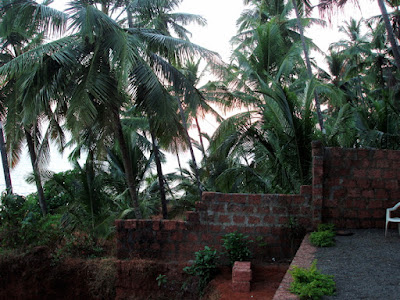
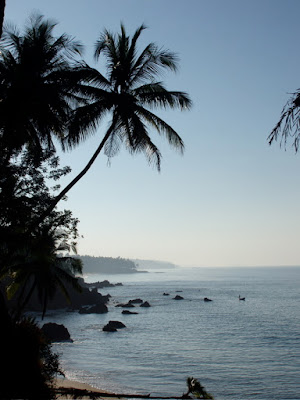
Here is the retaining wall just to the side of our house with the ocean through the palms. Immediately below our house dug out of the bluff going down to the beach, three workers (two men and a woman) were building a new house, as demand for this type of vacation is on the rise. It was interesting to see the process, completely by hand of carrying the large bricks (like you see in the wall), laying the mortar, and just seeing the walls go up brick by brick which will then be stucoed over, as our house was. The bricks were carried on the head of the woman mostly, who was wearing a large smock over flowing skirt. At the end of each day, she washed in a basin of water and rewrapped her beautiful sari, wet and combed her long hair neatly, and left her smock to hang for the next day.

Steve's body clock does not readjust very quickly, so he was up before dawn the next morning. The pictures below are of the sunrise over the Sea. I think perhaps you can see some of the subtle changes.
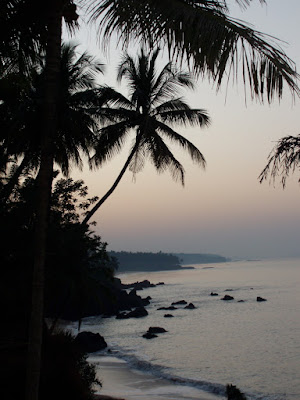
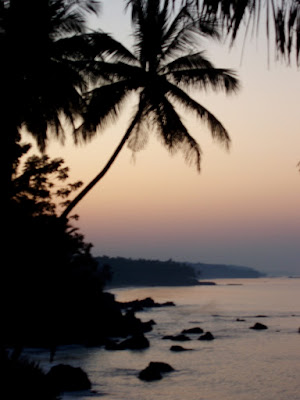
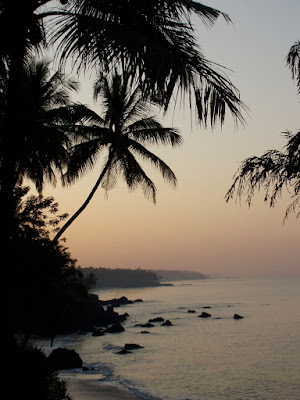
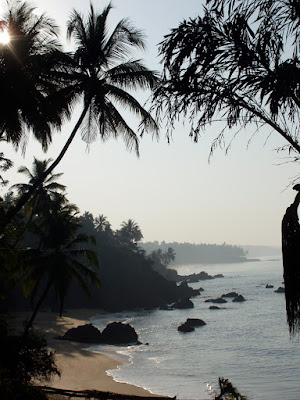

Below is looking to the north rather than the south in the full morning light.
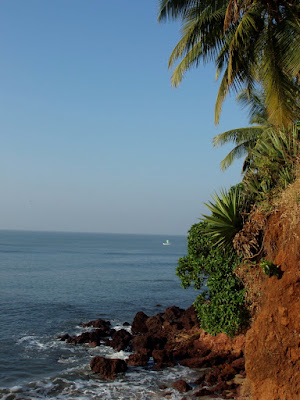
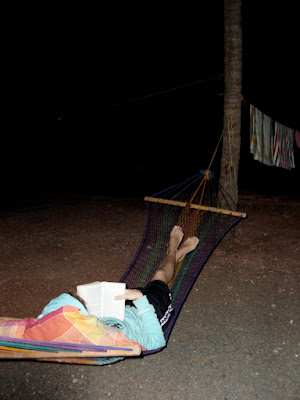
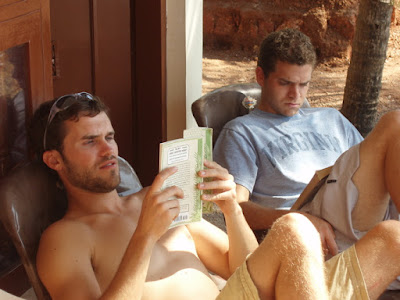
Our occupations during our days in paradise can be summed up in just a few words and phrases: read, read, and read some more, swim in the 75 degree water for a long, long time, play games, lay on the beach or in the hammock and stare out into space listening to the throb of the waves on the shore, eat, drink hot tea with cream and sugar, have conversation, sleep.
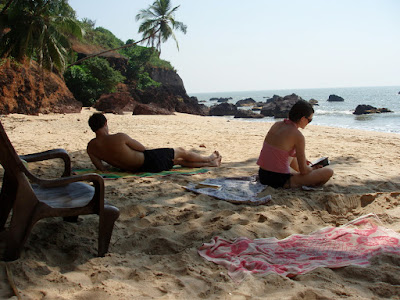
Though the picture doesn't do the experience justice, I had to take a picture of what it looked like laying flat on the sand and staring up through the palms as the fronds clacked gently in the sea breeze.
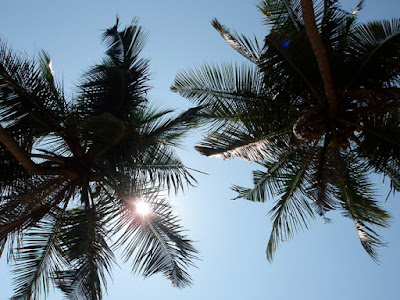
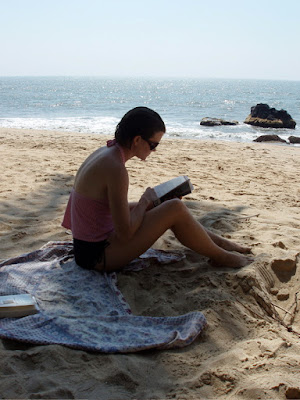
Was the beach as empty as it appeared? Yes, it was. At any one time the most non-Garbers on the beach were about five--a British couple and another British family and the occasional Indian fisherman or school boy checking out the folks on the beach (They were usually hanging around on the bluff in the trees afer school hours.).
We followed local tradition and conventional wisdom and put on our cover-ups when out of the water.
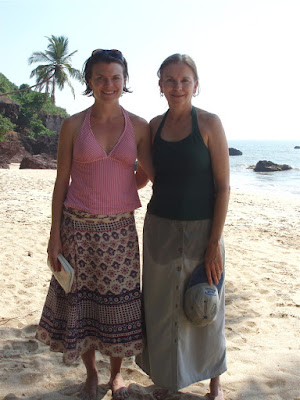

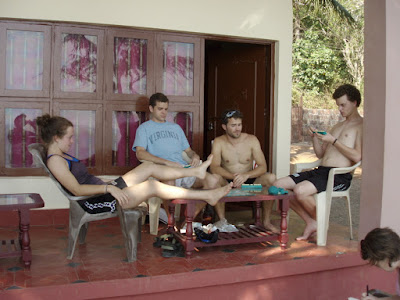
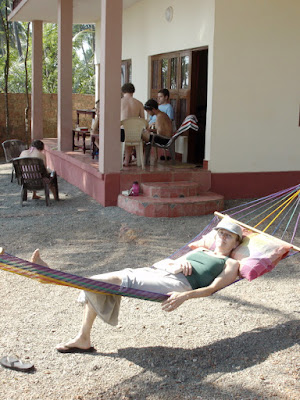
The jacket and hood were more for protection from the mosquitos than the chill.
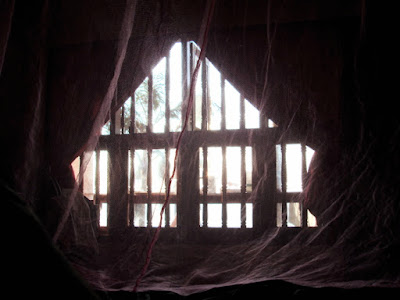
Morning view from bed through the pink mosquito net and out the window.
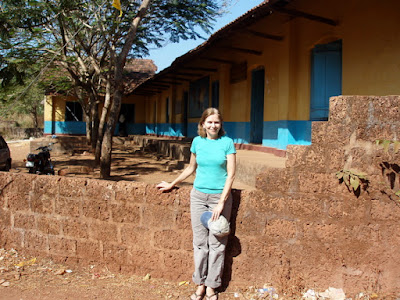
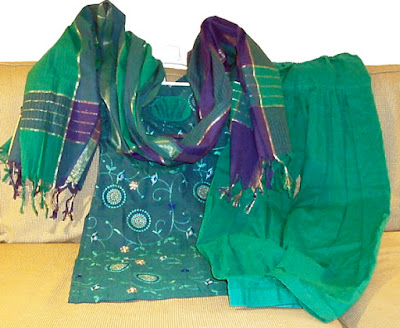
Some of the kids took a 10 minute walk up the high-banked lane to the village of shops. Eden found a little women's tailor shop and ordered an outfit. So the next morning Steve and I walked to the same, chose material, and I ordered a tunic, pants and scarf. They were to be ready for me by 5:00 that afternoon. In the walk, we passed the local school which is the building in this picture.
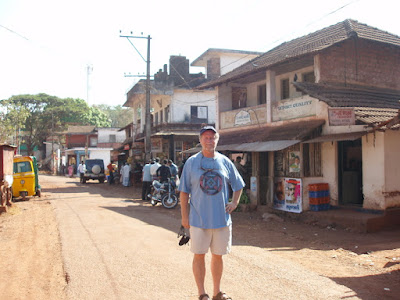
Steve on the village street
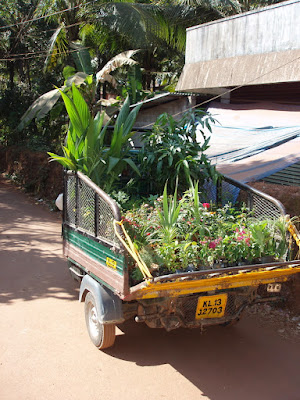
Here is what we called "The Flower Truck." It seemed to be going from house to house either selling potted flowers or replenishing the ones they had on some sort of prior agreement. The Indians value their flowers a great deal.
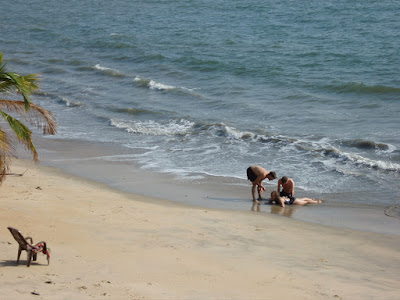
Jessica here is receiving a "sand treatment," good for exfoliating the skin.
We have to get the kids in a beach picture if we can!
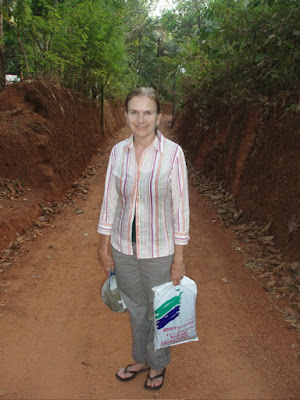
Here I am with my lady tailors, holding the material which became my outfit. I guess smiling for pictures isn't customary, but they did enjoy looking at the picture in the camera afterwards. Whoa--Am I really that much taller than all of them?
The high-banked lane to the village
Here is the finished product. I'm looking forward to wearing it this week at our school's International Night :).
Fallen palm under which we sat for shade and sat upon for fun


So hard to leave paradise, but aren't we glad we have the hope of seeing it again...and all the other incredible places we'll get to explore in the New Earth/New Heavens. As Steve always says, "I want to spend a milenium in ____________" Add to that Kerela on the Arabian Sea.

Friday, February 08, 2008

India Journal -- Part 3 -- New Year's Day 2008

Day 5 – Tuesday, New Year’s Day

We were up and ready for a driver from the Christian Medical College in a land rover to pick us up and take us to a medieval fort two hours away called Gingee Fort. The trip there was scary but interesting. The driving there is ALWAYS scary, but on the way at least the driving wasn’t struggling with falling asleep. But the scenery that we were passing was interesting—villages and houses and fields and rice paddies. On the road were lots of people walking with HUGE loads of various things on their heads, ox carts with HUGE loads of things, and many other kinds of conveyances. One of the most interesting little settlements was of low to the ground mud huts with long grass roofs in a walled compound with a satellite dish in the middle of it.


A little shrine by the side of the road complete with idol
Man on a bike with a huge load of dried palm fronds

The chicken shop!
Banana transport
We went through a very large and crowded city the name of which we did not know and probably never will. Just think--all those people bustling every day in busy
and probably stressful lives that we are totally ignorant of.
That's our driver reflected in the side view mirror of the vehicle.

The auto rickshaw, an indispensible means of transportation in the cities.
This looks like a very nice one.

Why waste a two-wheel vehicle on just one person. Many carry whole families.
This isn't why I took the picture, but on looking at it later,
I noticed I caught one of the few overweight people that I saw.

We saw a good number of ox carts on the road, sharing equally with all other vehicles.

Mud abode.
I wonder if there is an animal(s) of some kind shaded under that overturned basket.
Interesting combination of vehicles---old road roller, ox cart (with friendly man eager to wave at the white people--as were most people), new model Toyota van behind ox cart, and our driver in the mirror in a land rover less than 10 years old)
Very surprised to see a pretty late model combine (I think) harvesting what looks like wheat.

In the town before the fort we stopped to get drinks and try to find a bathroom. There were kind of public bathrooms of the non-Western variety, so that is what we used. I asked Eden the best way to accomplish the task without soiling my clothes, and she gave me good advice that worked. :)

Elliott is enjoying coconut milk bought fresh from the coconut vendor. He is very good with his small machete at cutting them open perfectly.
On the way into the fort we walked through an old Hindu temple. Here I am, shoeless as required, standing awkwardly under very prominent and common temple symbols which you may or may not recognize.
A sort of self-appointed guide for the temple who sang a Christian hymn for us, presumably because we were white or would we dare hope he recognized something more in us?

The fort was crowded with people, partly because there was also a big Hindu temple up the road that crowds of folks were headed to. The pictures below are the gateway to the three-point fort. We stopped to pay a fee for our visit. The name of the fort is Gingee Fort. You can see more about it at http://en.wikipedia.org/wiki/Gingee_Fort
(Even though librarians NEVER recommend widipedia as a reliable source for everything!)

The next number of pictures below are all at and around the "Elephant Tank" as the sign says. This was all part of the large area where elephants were evidently kept.

The tank for bathing the elephants
Looking at something interesting...
Elephant stables
elephant girls
This is where they go/went in
elephant gate
elephant gate into the elephant pool
The granary of the fort--a huge stone building with two huge rooms inside.
And below, banyan tree fun
The fort was amazing. It was three fortresses dating back to 1200 AD when it was started by a local chief. It eventually became the three fortresses on three mountaintops—one for the kind, one for the queen (a new form of birth control), and one for someone else (forget). Over the next 800 years it was conquered by a number of warring groups, including the British. We climbed the 850 steps to only the King’s Fortress, passing the granary and the elephant’s pool and stable on the way. Many many Indians wanted to shake our hands and say, “wish you a happy new year,” along the way. There were also lots of monkeys there, and of course, we weren't happy with monkeys after what one did to Eden in Agra.


Beginning to climb the 850 steps to the king's fortress

"Wish you a Happy New Year!"
Some hidden enclave of a prince or princess (above)

Good view through a narrow opening in the bulwark to defend the fortress
or just to view the countryside around
At the king's palace. Well, you can see why he liked it!

View out towards the Queen's fortress. If they needed some distance in their relationship,
they had it!Whoa! On the edge!
Three special young men


A handsome Jonathan being observed by two beautifully clad young women
(Their saris are not atypical of even the most humble women.).


Poor little mangey monkeys hungrily gobbling up some cooked rice someone gave them.

Where we've been...


The Queen's Fortress
Back in town trying to find a cold drink. I think a drink was found but not cold.

We were heading back by mid-afternoon to Vellore though because we were catching the all night train to Kerela for our beach stay. The drive home was especially terrifying for me because everyone fell blissfully asleep except for me who was hoping and praying the driver didn’t do the same. We made it though and had the driver take us to the hospital where Elliott has the lab he works in. This is the hospital that Paul Brand did much work with leprosy patients that we’ve all read about. Jonathan and I both read Pain: The Gift Nobody Wants by Paul Brand and Phillip Yancey while we were there, much of which is set right in Vellore and the hospital area. Everyone was hot, tired, and stressed from the drive and anticipating leaving that night for Kerela. So we had some tense moments working out who would go where to get what and when before hurrying for a last meal at the Darling Hotel before racing around to get our stuff together for the next leg of the journey.
Elliott's lab
Christian Medical Hospital courtyard
Front entrance to the hospital
After a precarious rickshaw drive to the station (40 minutes in a rickshaw with mechanical difficulties) and then a wait along the tracks with many others (I can’t believe I didn’t get any pictures of the station and waiting by the tracks.) for our “sleeper AC class” accommodations, one above the lowest class sleeping accommodations. You get a blanket and pillow for your bunk, one of three tiered up the car wall and AC if needed.
On to the next adventure!
After a pretty decent night's sleep, view from the window in the morning.
My bunk above Jonathan
Three tiers of Garbers
First one up, of course, with bunk folded and reading, of course.

View from my bunkThe morning tea man was by
Reminds me of Granddad Elliott and his famous faces